
Yoga Therapy for Stress Management
A Yogic Approach to a Peaceful Life


Introduction
Stress has become a common part of modern life. Work pressure, family responsibilities, financial concerns, lack of sleep, social media, uncertainty, and constant mental activity can affect both the body and the mind.
A certain amount of stress is a normal part of life. It can help us respond to challenges. However, when stress becomes continuous and we do not get enough time to recover, it can affect our physical, mental, emotional, and social well-being.
In simple words we can say Stress is accumulation of access.
Yoga offers a holistic way to work with stress.
Yoga does not simply teach us how to stretch the body. It teaches us how to understand the mind and its fluctuations, regulate the breath, become aware of our reactions, and develop greater balance in daily life.
Yoga Therapy applies these traditional principles in a systematic and individualized way. It may use shatkarma, asana, pranayama, mudra ,bandha relaxation, meditation, lifestyle practices, and self-awareness according to the needs of the individual.
The goal is not to create a life without challenges. The goal is to develop the ability to meet life’s challenges with greater stability and awareness.
As some one says life is an enjoyment of our difficulties.
Understanding Stress Through Yoga
In everyday life, we often experience stress because something happens outside us and the mind reacts to it. Because around us anything can trigger Stess, there are endless causes of stress.
For example, a difficult conversation may create worry. A deadline may create fear. Uncertainty may create restlessness. Even when the situation has ended, the mind may continue thinking about it.
Yoga gives great importance to understanding these movements of the mind.
Patanjali begins his teaching of Yoga with:
“Yogaś citta-vṛtti-nirodhaḥ.”
— Yoga Sutra 1.2
This is commonly translated as:
“Yoga is the stilling of the pattern of the mind.”
The purpose is not to force the mind to stop thinking. Rather, Yoga helps us develop awareness of our thoughts and reactions so that we are not controlled by every thought or its pattern.
This is especially important for stress management.
When we learn to observe the mind, we can create a small space between what happens and how we respond.
That space can become the beginning of inner balance.
Yoga or Yoga Therapy purpose is not to torcher the mind its purpose to understand the mind.



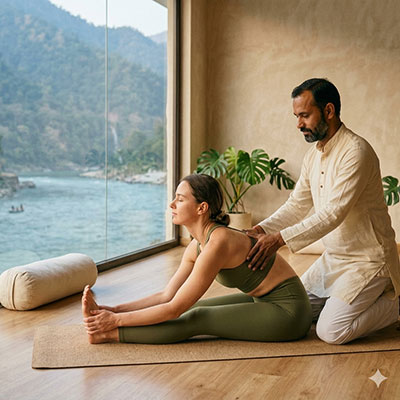
Why Yoga Therapy for Stress?
Yoga Therapy takes a holistic view of the person.
Stress does not affect only one part of us. We may experience:
- Physical tension
- Changes in breathing
- Restlessness
- Difficulty relaxing
- Emotional reactions
- Repetitive thoughts
- Poor sleep
- Difficulty concentrating
- Feeling mentally tired
Yoga Therapy therefore does not depend on one technique.
A suitable therapeutic program may combine:
Shatkarma + Asana + Pranayama + Mudra + Bandha + Relaxation + Meditation + Lifestyle + Food management + Self-awareness
The practices are selected according to the individual’s condition, age, physical capacity, lifestyle, and needs.
1. Shatkarma: Bring purification to the body
Shatkarama are six cleansing practices (Dhauti,Basti,Neti,Nauli,Tratak and Kapalabhati) which help us to detox the toxin from our body and mind.
In Yoga Therapy Shatkarma practices should be individualized.
Better to take a proper guadence from a yoga therapist before doing any shatkarama.
-
Asana: Bringing Ease to the Body
When we are under stress, the body may become tense. The shoulders may rise, the jaw may tighten, and the muscles may remain active even when there is no immediate physical danger.
Yoga asana can help us become aware of this unnecessary tension.
Patanjali gives a very important definition of asana:
“Sthira-sukham āsanam.”
— Yoga Sutra 2.46
It means that whichever position of body feel stable and combatable (effortless) that is Asana.
This teaching is very important in Yoga Therapy.
Yoga is not about forcing the body into difficult postures. For stress management, the focus should be on:
- Comfortable movement
- Awareness of the body
- Smooth breathing
- Appropriate effort
- Relaxation
- Stability
Gentle practices may include:
- Pawanmuktasana series
- Tadasana
- Marjariasana
- Balasana
- Gentle spinal movements
- Gentle twists
- Makarasana
- Supported forward movements
- Shavasana
The exact practices should be selected according to the person’s needs.
The important question is not:
“How difficult is my posture?”
The better question is:
“Can I remain aware, steady, and comfortable while practising?”
-
Pranayama: (Expansion Of Energy) Using the Breath as a Tool
Breathing is closely connected with our experience of stress.
When we are worried or excited, breathing may become faster or less comfortable. When we become calm, breathing often becomes quieter and more natural.
Yoga therefore gives an important place to prana and pranayama.
The traditional Yoga texts describe pranayama as a practice involving the regulation of breath.
Patanjali explains:
“Tasmin sati śvāsa-praśvāsayor gati-vicchedaḥ prāṇāyāmaḥ.”
— Yoga Sutra 2.49
Pranayama is described in relation to the regulation of the movement of inhalation and exhalation.
For stress management, the first step should often be awareness of natural breathing, rather than immediately practising strong techniques.
Simple practices may include:
Slow, Comfortable Breathing, Diaphragmatic breathing.
Observe the natural breath and gradually make it smooth and comfortable without forcing it.
Dirgha Shvasa and Praswasa (Long breath in and out)
Develop awareness of breathing through the abdomen, rib cage, and upper chest in a relaxed manner.
Some pranayama is effective in stress management like.
- Nadi Shodhana
- Ujjayi
- Bharamri
Pranayama should be comfortable and non-straining.
Strong breath retention or forceful pranayama should not be prescribed automatically for everyone. In Yoga Therapy, practices should be individualized.
4. Mudra and Bandha
Some gesture and locks (Mudra and Bandha) should be recommended during the practice of Pranayama or Meditation.
- Prana Mudra
- Hridaya Mudra
- Gyan Mudra
- Chinna Mudra
Bandha practice should be practice under the guidance of good Yoga therapist.
5. Shavasana: Learning to Relax
Many people know how to work hard but do not know how to rest properly.
Shavasana gives us an opportunity to consciously release physical effort.
The body is placed comfortably, and attention is gradually brought to different parts of the body.
The practitioner observes areas of tension and allows them to soften.
Shavasana teaches an important lesson:
Rest is not laziness. Rest is a necessary part of balance.
A regular relaxation practice can help a person develop greater awareness of the difference between necessary effort and unnecessary tension.
6. Meditation: Learning to Observe the Mind
Stress becomes more difficult when we believe every thought that appears in the mind.
For example:
“I cannot handle this.”
“Something bad will happen.”
“Everything must go according to my plan.”
Meditation gives us an opportunity to observe such thoughts without immediately reacting to them.
Patanjali gives another important teaching:
“Abhyāsa-vairāgyābhyāṃ tan-nirodhaḥ.”
— Yoga Sutra 1.12
The fluctuations of the mind are addressed through abhyasa and vairagya—consistent practice and non-attachment.
Means let the thoughts come be aware of them but do not let yourself effected by them.
This can be applied to daily life.
Abhyasa means regularly practising what supports mental stability.
Vairagya means developing freedom from excessive attachment.
For example:
“I will do my best, but I cannot control every outcome.”
This simple attitude can be deeply useful in stressful situations.
For this meditation Tanique can be guided by a yoga therapist according to the condition of a person.
-
The Bhagavad Gita and the Management of Stress
The Bhagavad Gita presents a powerful example of a person facing an intense emotional and psychological crisis.
Arjuna is confused, emotionally overwhelmed, and unable to decide what to do.
Krishna does not simply tell him to run away from the situation.
Instead, Krishna teaches him about dharma, action, knowledge, self-discipline, and equanimity.
One of the most relevant teachings is:
“Samatvaṃ yoga ucyate.”
— Bhagavad Gita 2.48
“Equanimity is called Yoga.”
This is highly relevant to stress management.
We cannot control everything that happens around us.
We cannot completely control:
- Other people’s behaviour
- The future
- Every situation
- Every result
- Unexpected events
But we can work on our own response.
Yoga teaches us to develop a mind that can remain balanced in both favourable and unfavourable situations.
-
Karma Yoga: Work Without Excessive Attachment
Another important teaching of the Bhagavad Gita is:
“Karmaṇy-evādhikāras te mā phaleṣu kadācana.”
— Bhagavad Gita 2.47
The verse teaches us to focus on our action rather than becoming excessively attached to the result.
This does not mean that results are unimportant.
It means that our responsibility is primarily toward the quality and sincerity of our action, while recognizing that the final result is influenced by many factors.
For example:
Instead of constantly thinking:
“I must get the result I want.”
we can cultivate:
“I will make the best effort I can, remain aware of my actions, and accept what is beyond my control.”
This attitude can reduce unnecessary mental pressure.
- Maitri, Karuna, Mudita and Upeksha
Patanjali gives a beautiful teaching for developing a peaceful mind:
“Maitrī-karuṇā-muditopekṣāṇāṃ sukha-duḥkha-puṇyāpuṇya-viṣayāṇāṃ bhāvanātaś citta-prasādanam.”
— Yoga Sutra 1.33
Patanjali recommends this for Chitta Prasadana (Mental hygiene).
We should behave like this in Different situation with people and surrounding
- Sukha (Happy) — Maitri (friendliness)
- Dukha (Pain) — Karuna (compassion)
- Punya (doing well) — Mudita (appreciative)
- Apuṇya (Not doing well) — Upeksha (Ignorance)
These qualities can help create a calmer mental environment.
- The Five Koshas: A Holistic View of the Person
The Taittiriya Upanishad presents the teaching of the five koshas, or five layers/sheaths:
- Annamaya Kosha — physical dimension
- Pranamaya Kosha — energy/breath dimension
- Manomaya Kosha — mind dimension
- Vijnanamaya Kosha — understanding and discrimination
- Anandamaya Kosha — the dimension associated with bliss
These are described in the Taittiriya Upanishad, Brahmananda Valli, 2.1–2.5.
This model gives Yoga Therapy a broad way of understanding human experience.
Stress may be experienced at different levels.
Annamaya
We may experience physical tension, fatigue, or discomfort.
Pranamaya
Our breathing and sense of vitality may change.
Manomaya
We may experience worry, fear, irritation, or repetitive thoughts.
Vijnanamaya
Our ability to understand a situation clearly may become affected by strong emotions or habitual thinking.
Anandamaya
Yoga philosophy points toward a deeper dimension of inner peace and wellbeing.
The five-kosha model should be understood as a traditional philosophical framework, not as a modern medical diagnostic system.
- Yoga Therapy and Daily Lifestyle
Yoga is not limited to the time spent on a yoga mat.
If a person practises Yoga for 30 minutes but spends the remaining day in constant overwork, poor sleep, excessive stimulation, and unhealthy routines, stress may continue.
Therefore, Yoga Therapy should also encourage healthy daily habits.
Simple principles include:
Regular sleep
Try to maintain a consistent sleep and waking routine.
Mindful eating
Eat with awareness and avoid making every meal a rushed activity.
Digital breaks
Give the mind regular periods without unnecessary digital stimulation.
Time for silence
Spend a few minutes every day without constant conversation, entertainment, or information.
Regular movement
Include appropriate physical movement according to individual needs.
Self-observation
At the end of the day, ask:
“What created tension in me today?”
“How did I respond?”
“What could I do differently tomorrow?”
This simple practice develops svadhyaya, or self-study.
- A Simple Yoga Therapy Routine for Stress
A general routine may be structured as follows. It should be modified according to the individual’s needs.
Morning Practice — 35 Minutes
- Centering — 2 minutes
Sit comfortably and observe the natural breath.
- Gentle joint and body movements — 5 minutes
Move the neck, shoulders, spine, and other comfortable areas slowly.
- Gentle asana — 10 minutes
Practise a few comfortable postures without strain.
- Breath awareness/pranayama — 10 minutes
Practise slow, smooth breathing or an appropriate pranayama.
- Quiet sitting — 5 to7 minutes
Observe the breath and thoughts without trying to control them.
- Sankalpa — 1 minute
Repeat a simple intention such as:
“I will respond with awareness rather than react automatically.”
- Stress Management Through Yama and Niyama
The first two limbs of Patanjali’s eight-limbed Yoga are Yama and Niyama.
They provide principles for living and self-discipline.
Some of them have direct relevance to stress.
Ahimsa — Non-harming (First Yama)
This includes developing a less aggressive relationship with ourselves.
Constant self-criticism can create unnecessary mental pressure.
Satya — Truthfulness (Second Yama)
Being honest with ourselves helps us understand what we are actually experiencing rather than constantly denying it.
Santosha — Contentment (Second Niyama)
Contentment does not mean giving up ambition.
It means learning to appreciate the present while continuing to act responsibly.
Svadhyaya — Self-study (Fourth Niyama)
Observe your thoughts, emotions, habits, and reactions.
Ishvara Pranidhana — Surrender to a higher reality (Fifth Niyama)
This encourages humility and the recognition that we cannot control everything.
These principles show that Yoga’s approach to stress is not limited to physical exercises.
It includes the way we live and the way we think.
- What Is the Real Goal of Yoga Therapy?
The goal is not simply:
Relaxation is valuable, but Yoga points toward something deeper.
The goal is to develop:
- Greater self-awareness
- Better emotional balance
- A steady relationship with the breath
- Greater physical ease
- Clearer thinking
- Reduced reactivity
- Healthy habits
- Inner stability
The Bhagavad Gita expresses this beautifully through the idea of samatva, or equanimity.
Yoga teaches us that peace does not necessarily come from making everything outside us perfect.
It comes from developing greater balance within ourselves.
Conclusion
Stress is a part of human life. We cannot always remove difficult situations, but we can learn to respond to them with greater awareness.
Yoga Therapy provides a holistic path by working with the body, breath, mind, behaviour, and lifestyle.
Shatkarma detox our toxnis.
Asana can develop physical awareness.
Pranayama can help us work consciously with the breath.
Mudra and Bandha stimulated of channelised of nadies for better Prana flow.
Relaxation can teach the body to release unnecessary effort.
Meditation can help us observe the mind.
Yogic philosophy can help us develop a wiser relationship with situations, people, and outcomes.
Patanjali says:
“Yogaś citta-vṛtti-nirodhaḥ.”
Yoga is the discipline of bringing greater steadiness to the movements of the mind.
And the Bhagavad Gita reminds us:
“Samatvaṃ yoga ucyate.”
Equanimity is Yoga.
Therefore, the yogic approach to stress management is not about escaping life.
It is about learning to live with greater awareness, steadiness, compassion, and balance.
Yoga does not promise a life without challenges.
It teaches us how to face those challenges without losing ourselves in them.
References
Primary Scriptural Sources
- Patanjali. Yoga Sutras of Patanjali.
- Sutra 1.2 — Yogaś citta-vṛtti-nirodhaḥ
- Sutra 1.12 — Abhyāsa-vairāgyābhyāṃ tan-nirodhaḥ
- Sutra 1.33 — Maitrī-karuṇā-muditopekṣāṇāṃ… citta-prasādanam
- Sutra 2.46 — Sthira-sukham āsanam
- Sutra 2.49 — Definition of pranayama
- Sutra 2.16 — Heyaṃ duḥkham anāgatam
- The Bhagavad Gita
- Chapter 2, Verse 47 — Karmaṇy-evādhikāras te…
- Chapter 2, Verse 48 — Samatvaṃ yoga ucyate
- Chapter 2, Verse 50 — Yogaḥ karmasu kauśalam
- Taittiriya Upanishad
- Brahmananda Valli, 2.1–2.5 — Teaching of the five koshas
- Bhrigu Valli, Chapter 3 — Bhrigu’s inquiry into the nature of Brahman and the progressive understanding through food, life, mind, knowledge, and bliss
The five-kosha teaching is specifically presented through the Annamaya, Pranamaya, Manomaya, Vijnanamaya, and Anandamaya dimensions.
Recommended Translations and Study Sources
- Swami Vivekananda. Raja Yoga.
A classic English presentation and interpretation of Patanjali’s Yoga Sutras. - Swami Sivananda. The Bhagavad Gita.
A traditional interpretation of the teachings of the Gita. - Swami Nikhilananda. The Upanishads.
An English translation and traditional presentation of the principal Upanishadic teachings. - Swami Sharvananda. Taittiriya Upanishad.
Translation and explanation of the Taittiriya Upanishad and its teachings on the five sheaths. - Taittiriya Upanishad — Brahmananda Valli.
The primary scriptural source for the five-kosha teaching.
Written By
Dr. Mahesh (Assistant Professor)
Rajshree Yog Sansthan Rishikesh
Director : Rishikesh Yoga Therapy School
P.G.D. in Yogic Science (Gold Medallist)
M.Sc. in Yogic Science (Gold Medallist)
Master in Philosophy
Diploma in Yoga Therapy
Ph.D. in Yoga Therapy